Cobwebs of WebRTC: Weaving Py-libp2p's Transport

Astrophile? Nerd? Tech-savvy? alchemy of heterogeneous elements, if either above matches your vibe, let's connect and talk!
WebRTC: Web Real-Time Communication : a way for two machines to talk directly over the internet, even behind firewalls, with low latency. It’s not “video tech”. It’s a transport. The browser ships it, which is why it matters. ;))
Contributors: @Nkovaturient, @sukhman-sukh, @asmit27rai
Informative Links:
My Implementation: [py-libp2p WebRTC transport](https://github.com/libp2p/py-libp2p/pull/780)
Reference Implementation: [js-libp2p WebRTC](https://github.com/libp2p/js-libp2p/tree/main/packages/transport-webrtc)
WebRTC Spec: [libp2p WebRTC spec](https://github.com/libp2p/specs/blob/master/webrtc/webrtc.md)
Circuit Relay v2 Spec: [Circuit Relay spec](https://github.com/libp2p/specs/blob/master/relay/circuit-v2.md)
aiortc: [Python WebRTC implementation](https://github.com/aiortc/aiortc)
trio-asyncio: [Async runtime bridge](https://github.com/python-trio/trio-asyncio)
Introduction
Overview of WebRTC and its significance in real-time communication
WebRTC = a browser-provided transport that does NAT traversal (ICE/STUN/TURN), secure channels (DTLS), and data channels (SCTP) so apps can send bytes peer-to-peer with low latency.
Think of it like punching a temporary tunnel through firewalls instead of routing through servers.
Key components :
SDP: offer/answer metadata for the connection.
ICE (STUN/TURN): candidate discovery and fallbacks for NATs.
DTLS: crypto for the channel.
SCTP/RTCDataChannel: how arbitrary data moves.
These are the plumbing you wire into libp2p’s transport layer.
The Two Flavors of WebRTC
Before diving in, let me clarify something: libp2p has two different WebRTC transports, and they solve very different problems.
1) WebRTC Private-to-Private (/webrtc)

The Problem: Both peers are behind NAT with private IPs. They can't directly connect.
The Solution: Use Circuit Relay v2 for signalling. A public relay server helps coordinate the connection, then peers establish direct WebRTC connection using ICE/STUN/TURN.
Multiaddr Format:
/ip4/127.0.0.1/tcp/9000/p2p/QmRelay.../p2p-circuit/webrtc/p2p/QmPeer...
Use Case: Browser-to-browser connections, mobile devices, home networks
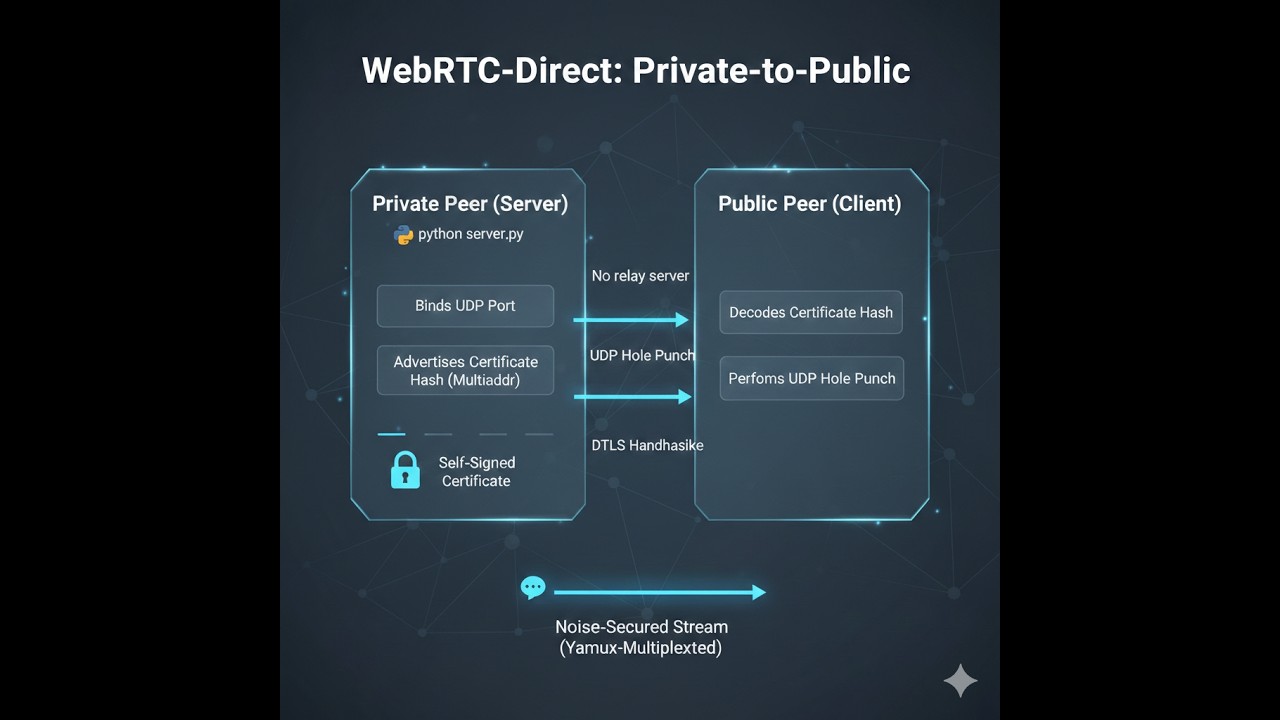
2) WebRTC-Direct (/webrtc-direct)

The Problem: At least one peer has a public IP. We want the fastest possible connection.
The Solution: Direct UDP hole-punching with SDP munging. No relay needed for signaling.
Multiaddr Format:
/ip4/192.0.2.1/udp/9090/webrtc-direct/certhash/uEiAb.../p2p/QmPeer...
Use Case: Client connecting to public server, CDN nodes, bootstrap peers
But First things First: if you hv no idea of Libp2p? py-libp2p?
Libp2p is a networking stack, not a protocol. It gives one:
transports (TCP, QUIC, WebRTC, etc.)
stream muxing
encryption
peer discovery, [and other **Lib**rary of modules to support p2p connection ]
To the point, its a modular P2P stack. Py-Libp2p brings that stack to Python so that python processes can participate in the same mesh as JS, Go, etc. Its a modular peer-to-peer networking framework that powers decentralized systems like IPFS, Filecoin, and Ethereum 2.0.
My work plugs WebRTC into py-libp2p so Python nodes talk to each other via webrtc transport support and other libp2p modules reliably.

Core features of Py-libp2p
| Modular Transport Layer (TCP, WebSocket, QUIC, and now WebRTC) | Secure Communication (Noise Protocol, TLS 1.3, Peer Auth) | Stream Multiplexing (Yamux, mplex) |
|---|---|---|
| Peer Discovery & Routing (kad-DHT, mDNS, Pubsub) | Circuit Relay v2 (NAT traversal) | Connection Management |
Why WebRTC in Py-Libp2p?
1. Browser-Native P2P
Direct browser connectivity without server dependencies
Enables decentralized web applications (dApps) to run entirely in browsers
Python nodes can communicate directly with JavaScript/browser peers
2. Superior NAT Traversal
ICE/STUN/TURN built-in for robust firewall penetration
Works in restrictive network environments where TCP/WebSocket fail
Reduces reliance on relay servers (lower latency, costs)
3. Mobile & IoT Support
WebRTC works on mobile browsers and native apps
Essential for decentralized mobile applications
Enables IoT devices to participate in P2P networks
4. Standardized & Battle-Tested
W3C standard with massive industry adoption (Zoom, Google Meet, Discord)
Proven reliability at global scale + Extensive tooling and debugging support
5. Dual Transport Strategy
WebRTC-Direct (
/webrtc-direct): Fast public-to-public connectionsWebRTC Private-to-Private (
/webrtc): NAT-to-NAT via relay signaling
6. Ecosystem Interoperability
js-libp2p already supports WebRTC (browsers, Node.js)
Python nodes can now join the same P2P networks as JavaScript
Critical for cross-language decentralized systems
Real-World Impact
| Without WebRTC: | With WebRTC: |
|---|---|
| Python P2P apps can't reach browsers | Full-stack decentralization: Python backends ↔ browser frontends |
| Limited to server-side nodes only | Hybrid architectures: Python for heavy compute, browsers for UI |
| Excludes 90% of potential users (web/mobile) | True peer equality regardless of platform |
Gearing & Revvin’ up your engine
Required Arsenals and Armor : Essential Knowledge
1. Core Foundations
libp2p fundamentals: Peer IDs, multiaddrs, transports, streams
py-libp2p architecture: Host, swarm, upgrader, protocol muxing
Python async:
trioevent loop (py-libp2p uses trio, not asyncio)WebRTC basics: Peer connections, signaling, ICE, data channels
2. WebRTC Transport Types (Critical Distinction)
WebRTC Private-to-Private (
/webrtc): [Browser ↔ Browser (both behind NAT)]WebRTC-Direct (
/webrtc-direct): [Browser ↔ Public Server]
3. Key Techs
| Python Libraries | Networking Concepts: |
|---|---|
| aiortc: WebRTC implementation (handles RTCPeerConnection, ICE, DTLS, SCTP) | Circuit Relay v2: Relay protocol for NAT traversal signaling |
| trio-asyncio: Bridge between trio (py-libp2p) and asyncio (aiortc) | NAT traversal: ICE, STUN, TURN, UDP hole punching |
| py-multiaddr: Address format parsing/encoding | DTLS/SCTP: Encryption and reliable transport over UDP |
| Noise Protocol / AutoTLS: libp2p's security protocols |
4. WebRTC Connection Components
Connection Establishment:
SDP (Session Description Protocol): Offer/Answer exchange
ICE candidates: Network address discovery
Data channels: Application data streams
Security Layers:
Certificate generation: For WebRTC-Direct authentication
Certhash: SHA-256 multihash of TLS certificate (in multiaddr)
Noise handshake: Post-WebRTC authentication/encryption
5. libp2p Protocol Constants
/webrtc-signaling/0.0.1- Signaling protocol ID/libp2p/circuit/relay/2.0.0- Circuit Relay v2 HOP protocol/noise- Noise Protocol for security upgrade/yamux/1.0.0- Stream multiplexer
Multiaddr component codes: /webrtc, /webrtc-direct, /certhash, /p2p-circuit
Working Demos
1) WebRTC-Direct
# Terminal 1 — Server
python examples/chat_webrtc/webrtc-direct/public_peer.py

# Terminal 2 — Client
python examples/chat_webrtc/webrtc-direct/private_peer.py
Flow: direct UDP hole punch → ICE → DTLS (certhash verification) → SCTP → Noise (server initiates) → Yamux → chat stream
2) WebRTC Private-to-Private
# Terminal 1 — Circuit Relay
python examples/chat_webrtc/webrtc-pvt-to-pvt/relay.py

# Terminal 2 — Alice (Listener)
python examples/chat_webrtc/webrtc-pvt-to-pvt/peer_node.py --mode listen

# Terminal 3 — Bob (Dialer)
python examples/chat_webrtc/webrtc-pvt-to-pvt/peer_node.py --mode dial
Flow: SDP signaling over relay circuit → ICE → DTLS → SCTP → Noise → Yamux → direct P2P chat
Screencasts
Demo 1 — WebRTC-Direct Chat
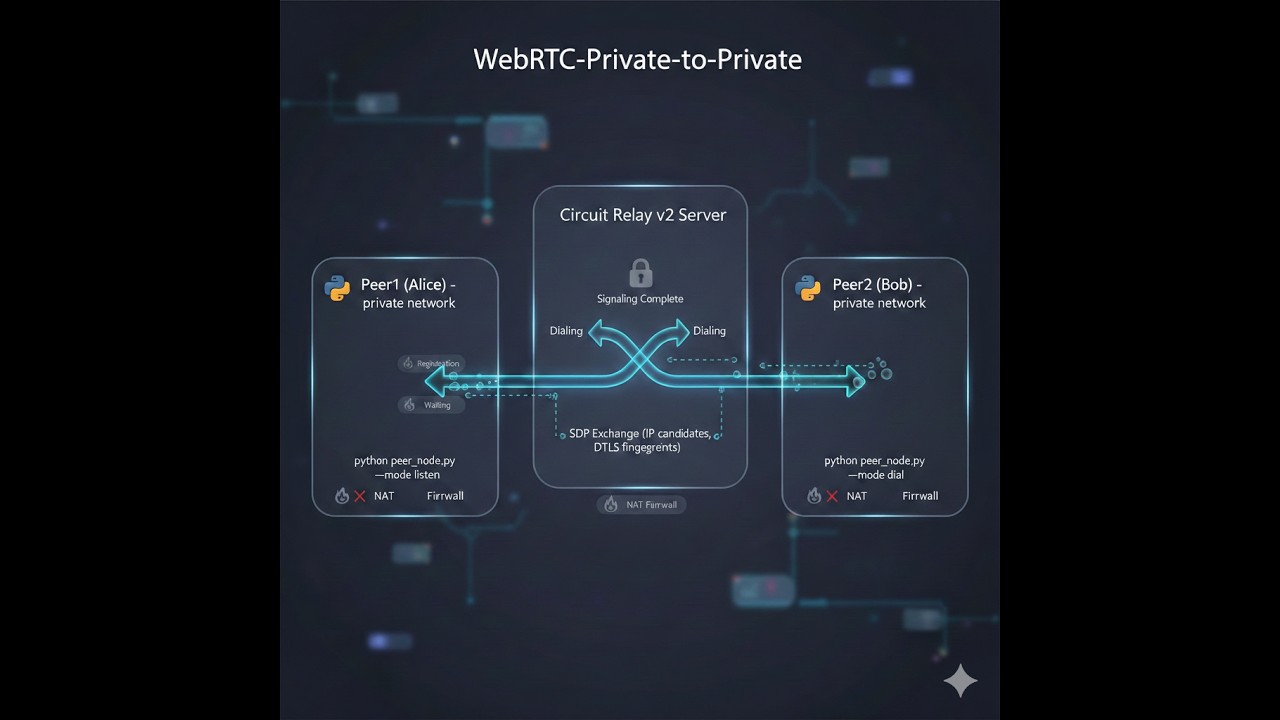
Demo 2 — WebRTC Pvt-to-Pvt Chat
Lets Kickstart the engine and cook it!
Protocol Registration: A Necessary Foundation
Before either transport works, py-multiaddr needs to know about three new protocol codes — webrtc (0x0119), webrtc-direct (0x0118), and certhash (0x01D2). These codes match js-libp2p exactly, which matters for cross-implementation interoperability.
Registration happens in multiaddr_protocols.py via a side-effect import:
webrtc_protocol   = Protocol(code=0x0119, name="webrtc",        codec=None)
webrtc_direct     = Protocol(code=0x0118, name="webrtc-direct", codec=None)
certhash_protocol = Protocol(code=0x01D2, name="certhash",      codec="fspath")
certhash uses a variable-length string codec because it holds a base64url-encoded multihash. Every file using either transport must include:
from libp2p.transport.webrtc import multiaddr_protocols # noqa: F401
Omitting it causes silent failures when parsing those multiaddrs — no obvious error, just a codec lookup miss.
Part I: WebRTC Private-to-Private Setup
The Core Challenge: Making Two Strangers Talk in Py-libp2p
The fundamental problem with WebRTC private-to-private is coordination. How do two peers, neither of which knows the other's address, establish a connection?
The answer: Circuit Relay v2 + WebRTC signaling protocol.
Here's the flow I implemented:
Alice                    Relay                    Bob
  │                        │                       │
  │◄─── Reservation ───────┤                       │
  │                        │◄─── Reservation ──────│
  │                        │◄─── Circuit open ─────│
  │◄─── STOP (circuit) ────┤                       │
  │                        │                       │
  │◄────────── /webrtc-signaling/0.0.1 ────────────►│
  │      SDP offer + ICE candidates                 │
  │      SDP answer + ICE candidates                │
  │                        │                       │
  │◄══════════════ Direct UDP (WebRTC) ═════════════►│
  │         DTLS → SCTP → Noise → Yamux             │
  │         /yamux/1.0.0                                │
Alice's Startup Sequence — Order Matters
Register the application stream handler on the host first — before transport starts. Once Bob's WebRTC connection lands, the swarm immediately tries to serve the stream. The handler must be in place.
Register
CircuitV2Protocol(allow_hop=False)with the STOP handler. Alice is a client, not a relay, but she still needs STOP to accept incoming circuits from the relay.Connect to the relay and pre-register its protocols in the peerstore.
WebRTCTransport._setup_circuit_relay_support()queries the peerstore to discover relay-capable peers via the HOP protocol ID. If those protocols aren't pre-registered after connecting, relay discovery fails silently.Call
transport.start(), which does three things in sequence:Spawns the asyncio bridge system task and waits for
_loop_readyRegisters the
/webrtc-signaling/0.0.1handler on the hostCalls
_setup_circuit_relay_support(), which creates an internalCircuitV2Protocol,TrioManager,RelayDiscovery, andCircuitV2Transport
Call
transport.ensure_listener_ready(), which queries relay discovery, callsmake_reservation()on the relay via HOP RESERVE, and composes Alice's advertised multiaddr:
webrtc_addr = base_addr.encapsulate(
    Multiaddr(f"/webrtc/p2p/{local_peer.to_base58()}")
)
# Result: /ip4/.../tcp/.../p2p/<relay-id>/p2p-circuit/webrtc/p2p/<alice-id>
This address is written to alice_webrtc_addr.json for Bob to read.
Bob's Dial Chain
transport.dial(alice_maddr) orchestrates the entire signaling flow:
Step 1 — ensure_signaling_connection(maddr): Parses the circuit address, extracts relay and Alice's peer IDs, dials the relay, makes Bob's own reservation, then calls _relay_transport.dial_peer_info() with Alice's circuit address. The swarm upgrades this relay connection with Noise + Yamux — this TCP-over-relay path is the signaling channel.
Step 2 — initiate_connection(): Runs inside with_webrtc_context(). Bob creates an RTCPeerConnection with STUN servers configured, initialises a data channel, generates an SDP offer, and opens a /webrtc-signaling/0.0.1 stream over the relay circuit to Alice. The offer is sent as a varint-length-prefixed protobuf message.
Step 3 — Alice's signaling handler fires: _handle_signaling_stream(), registered during transport.start(), creates Alice's RTCPeerConnection, sets Bob's offer via setRemoteDescription, generates an SDP answer, and writes it back on the same stream.
Step 4 — ICE negotiation: Both sides extract ICE candidates from the SDP and call addIceCandidate(). STUN servers (Google, Twilio, Cloudflare, Mozilla — configured in constants.py) provide reflexive candidates for NAT traversal. ICE tries candidate pairs until one works.
Step 5 — DTLS handshake: Fingerprints were in the SDP. Both sides verify. SCTP data channel opens.
Step 6 — Swarm upgrade and stream open: The raw WebRTC connection is upgraded with Noise + Yamux. Bob calls host.new_stream(alice_id, [CHAT_PROTOCOL]), multistream-select negotiates the application protocol, and the stream is delivered to Alice's registered handler. The relay circuit is now idle — data flows direct.
Component 1: Circuit Relay v2 Integration
Circuit Relay v2 was freshly implemented in py-libp2p, but integrating it with WebRTC required understanding the HOP and STOP protocols.
The First Gotcha: I initially tried to use the relay as a simple passthrough, but Circuit Relay v2 requires proper reservation and voucher handling. The relay needs to verify you have permission to use it.
allow_hop=True is the single flag that makes a node a relay rather than a relay client. Both HOP and STOP handlers must be registered:
relay_protocol = CircuitV2Protocol(host, limits=RELAY_LIMITS, allow_hop=True)
host.set_stream_handler(HOP_PROTO, relay_protocol._handle_hop_stream)
host.set_stream_handler(STOP_PROTO, relay_protocol._handle_stop_stream)
HOP handles reservation and circuit-open requests from peers.
STOP handles the relay-to-destination leg. Both must be registered or the relay silently refuses circuits.
Component 2: Establishing Signaling Connection through the relay
The connection must be fully upgraded (security + muxing) before you can use it for signaling streams. I initially tried to open the signaling stream on the raw connection and got cryptic errors about "protocols not supported."
Component 3: The Data Channel Dance
- WebRTC uses two types of data channels in libp2p's implementation:
Init channel - Temporary channel for SCTP establishment
Application channels - Where actual data flows
The Init Channel Problem
My first implementation tried to be clever with a negotiated init channel:
# My first attempt - seemed logical
init_channel = peer_connection.createDataChannel("init", negotiated=True, id=0)
Both peers would create this channel explicitly, and it should open immediately when SCTP connects. Right?
Wrong.
The channel stayed in "connecting" state forever, even though:
Connection state:
connected✅ICE state:
completed✅SCTP state:
connected✅
After comparing with js-libp2p, I found they use a non-negotiated init channel:
// js-libp2p approach
const channel = peerConnection.createDataChannel('init')  // Default: negotiated=false
The initiator creates it, the answerer receives it via datachannel event, and immediately closes it.
But I had already built the negotiated approach and it was actually more reliable for SCTP establishment verification in Python. So I kept it, with proper handling:
# Initiator side
init_channel = peer_connection.createDataChannel("init", negotiated=True, id=0)

# Answerer side - create matching channel BEFORE setRemoteDescription
init_channel = peer_connection.createDataChannel("init", negotiated=True, id=0)

# Ignore it if somehow received via datachannel event
def on_data_channel(channel: RTCDataChannel) -> None:
    if channel.label == "init" or getattr(channel, "id", None) == 0:
        logger.debug("Ignoring init channel (we created it as negotiated)")
        return
    # Handle application channel
    received_data_channel = channel
    data_channel_received.set()
Trade-off: This breaks strict interoperability with js-libp2p, but provides more reliable connection establishment in Python. I documented this decision and added a TODO to make it configurable.
Component 4: The Async Bridge Nightmare
One of the slight complex parts of this implementation was bridging aiortc (asyncio-based) with py-libp2p (trio-based).
Why complex?
- well, cuz aiortc expects to run in an asyncio event loop:
# aiortc's world
await peer_connection.setLocalDescription(offer)
peer_connection.on("datachannel", handler)
But py-libp2p uses trio:
# py-libp2p's world
async with trio.open_nursery() as nursery:
    await trio.sleep(1)
You can't just mix them. Calling aiortc from trio blocks the trio event loop. Calling trio from aiortc... well, that doesn't even make sense.
The Solution: trio-asyncio Bridge
- I built
async_bridge.pyto handle the translation:
The Gotcha: Event handlers registered in aiortc run in the asyncio context. To communicate back to trio, I used memory channels:
The error came from deep inside aiortc:
# aiortc/rtcdtlstransport.py:701
def _send_data(self, data: bytes) -> None:
    if self.state != "connected":
        raise ConnectionError("Cannot send encrypted data, not connected")
The Investigation
I added extensive logging and aha! The connection and ICE were ready, SCTP thought it was connected, but DTLS was still negotiating.
The Race Condition
Here's what was happening:
WebRTC connection establishes ✅
ICE completes ✅
SCTP transitions to "connected" ✅
We return the connection 🏁
Security upgrade starts multiselect negotiation
SCTP tries to send data
DTLS not ready yet ❌
Boom 💥
The problem: SCTP reports "connected" before DTLS is actually ready to send data.
The Fix
Wait for DTLS explicitly:
Root Cause: Handshake Registration Timing
The issue was in when I registered the handshake with my aiortc patch (more on that patch later).
My first attempt:
# TOO EARLY - connection not stable yet
register_handshake(peer_connection)
connection = WebRTCRawConnection(...)
# ... verify connection stability ...
return connection
The problem: register_handshake() tells the patch "this connection is doing a handshake, don't close it." But if the connection isn't actually stable yet, the patch can't help.
The fix:
# Verify connection is stable FIRST
if received_data_channel.readyState != "open":
    raise WebRTCError(f"Data channel not open: {received_data_channel.readyState}")

# Brief pause to let async operations settle
await trio.sleep(0.1)

# Verify connection didn't immediately close
if peer_connection.connectionState == "closed":
    raise WebRTCError("Peer connection closed immediately after creation")

# NOW register handshake - connection is verified stable
register_handshake(peer_connection)

# Create and return connection
connection = WebRTCRawConnection(...)
return connection
Key Learning: Defensive checks before registering handshake are crucial. Otherwise you're telling the system "protect this connection" when it's already doomed.
Component 5: The aiortc Patch
Speaking of the patch, let me explain why it exists.
The Problem: Premature Connection Closure
- aiortc would sometimes close connections during the Noise handshake:
# Somewhere in aiortc internals
peer_connection.close()  # ← This ruins everything
This happened because:
Some error condition triggered cleanup
Cleanup called
peer_connection.close()This stopped SCTP transport
Data channels closed
Noise handshake failed with
IncompleteReadError
The Solution: Runtime Patching
I created aiortc_patch.py to intercept and defer closures during handshakes:
To intercept RTCPeerConnection.close() during active handshakes:
_active_handshakes: set[RTCPeerConnection] = set()

def register_handshake(pc: RTCPeerConnection) -> None:
    _active_handshakes.add(pc)

def unregister_handshake(pc: RTCPeerConnection) -> None:
    _active_handshakes.discard(pc)

_original_close = RTCPeerConnection.close

async def patched_close(self: RTCPeerConnection) -> None:
    if self in _active_handshakes:
        logger.warning(f"Deferring close on {id(self)} — handshake active")
        return
    await _original_close(self)

RTCPeerConnection.close = patched_close
register_handshake()is called only after verifying the connection is stable — not before. And,unregister_handshake()is always called in afinallyblock, success or failure. The patch is applied automatically on import, similar to howaioice_patch.pyworks.
The Catch: This only prevents closure via peer_connection.close(). SCTP can still close independently due to DTLS errors, which is why the DTLS verification was critical.
Part II: WebRTC-Direct (Private-to-Public) Setup
After spending 'months'(research + learning) on private-to-private, I naively thought abt resuming work on WebRTC-Direct .
The Core Challenge encountered here are:
Certificate-Based Authentication : WebRTC-Direct uses a clever trick:
- instead of using a signaling server, connection details (IP, port, certificate hash) are embedded in the multiaddr itself:
/ip4/192.0.2.1/udp/9090/webrtc-direct/certhash/uEiAb.../p2p/QmPeer...
The certhash component is crucial—it's how the client verifies it's connecting to the right server. Its a trust anchor ⚓️
Component 1: Certificate Generation and Management
WebRTC requires TLS certificates. For WebRTC-Direct, these certificates serve dual purpose:
DTLS encryption
Peer authentication (via certhash)
Generating Certificates
The 14-Day Lifespan: Certificates expire after 14 days to limit the impact of compromised certificates. This requires a renewal mechanism.
Key Learning: Certificate management is easy to overlook but critical for production. Without renewal, your server becomes unreachable after 14 days.
Component 2: SDP Munging for NAT Traversal
WebRTC-Direct uses a technique called "SDP munging" to establish connections without a signaling server.
Server(Public Peer) Bootstrap
The server creates a libp2p host, starts WebRTCDirectTransport, and binds a listener on a UDP multiaddr:
transport = WebRTCDirectTransport()
transport.set_host(host)

async with trio.open_nursery() as nursery:
    await transport.start(nursery)

    listener = transport.create_listener(chat_handler)
    listen_maddr = Multiaddr(f"/ip4/0.0.0.0/udp/{udp_port}/webrtc-direct")
    ok = await listener.listen(listen_maddr, nursery)
When listener.listen() is called, it generates an ECDSA certificate via aiortc, computes its SHA-256 fingerprint as a multihash, and appends /certhash/<hash> to the advertised multiaddr.
Server Derives Answer from Multiaddr
The server doesn't receive the client's offer via a signaling channel. Instead, it derives the answer from the multiaddr:
Why This Works:
- Because ufrag == pwd, the server knows both from the offer alone. Combined with the server's IP/port from the multiaddr, it can construct a valid answer without additional signaling.
Client(Private Peer) Dial
transport.dial(server_maddr) parses the ufrag from the multiaddr (prefixed libp2p+webrtc+v1/), sends UDP hole-punch packets, performs ICE and DTLS, and opens the SCTP data channel via aiortc. The swarm then upgrades with Noise + Yamux.
Component 3: The Noise Handshake - Server Initiates
- This was one of the most confusing aspects. In standard libp2p, the dialer initiates security handshake. But in WebRTC-Direct, the server initiates Noise handshake.
Why Server Initiates
From the js-libp2p code comments:
For inbound connections, the server is expected to start the noise handshake. Therefore, we need to secure an outbound noise connection from the client.
This matches the browser security model—browsers expect servers to initiate TLS handshakes.
The Prologue Binding
WebRTC-Direct uses a special NOISE prologue that binds the handshake to the TLS certificates, preventing MITM attacks:
# libp2p/transport/webrtc/private_to_public/util.py:628-745

def generate_noise_prologue(
    local_fingerprint: str,
    remote_multi_addr: Multiaddr,
    role: str
) -> bytes:
    """Generate NOISE prologue binding handshake to WebRTC TLS certs.

    Format: "libp2p-webrtc-noise:" + remote_multihash + local_multihash
    """
    PREFIX = b"libp2p-webrtc-noise:"

    # Hash local fingerprint (SHA-256)
    local_fp_bytes = bytes.fromhex(local_fingerprint.replace(":", ""))
    local_digest = hashlib.sha256(local_fp_bytes).digest()

    # Create multihash (0x12 = SHA-256, 0x20 = 32 bytes)
    local_multihash = bytes([0x12, 0x20]) + local_digest

    # Extract remote certhash from multiaddr
    cert = extract_certhash(remote_multi_addr)
    remote_multihash = base64.urlsafe_b64decode(cert[1:])  # Remove 'u' prefix

    # Order depends on role
    if role == "server":
        return PREFIX + remote_multihash + local_multihash
    else:  # client
        return PREFIX + local_multihash + remote_multihash
Handshake Execution
# libp2p/transport/webrtc/private_to_public/connect.py:1285-1320

# Generate prologue
noise_prologue = generate_noise_prologue(
    local_fingerprint,
    remote_addr,
    role
)

# Get NOISE transport
transport = security_multistream.transports[NOISE_PROTOCOL_ID]
transport.set_prologue(noise_prologue)

# Server initiates, client waits
if role == "client":
    logger.info("Client calling secure_inbound (waiting for server)...")
    secure_conn = await transport.secure_inbound(raw_connection)
else:  # server
    logger.info("Server calling secure_outbound (initiating handshake)...")
    secure_conn = await transport.secure_outbound(
        raw_connection,
        remote_peer_id
    )
Critical Detail: The prologue order (local+remote vs remote+local) is symmetric by design — both sides compute the same bytes in opposite order. If they don't match, the Noise XX handshake fails. The prologue is set on the transport via transport.set_prologue(noise_prologue) before any handshake call.
WebRTC private-to-private uses a standard prologue instead, goes through full multistream-select negotiation, and uses the dialer as Noise initiator — matching the normal libp2p upgrade path.
| WebRTC-Direct | WebRTC Pvt-to-Pvt | |
|---|---|---|
| Noise initiator | Server (secure_outbound) |
Dialer (is_initiator=True) |
| Prologue | Special — binds TLS fingerprints | Standard |
| Multiselect | Skipped | Full negotiation |
| Handshake channel | Dedicated id=0, negotiated=True |
Main data channel |
Component 4: The Message Handler Timing Disaster
This bug took me two weeks to find.
Handshake timeouts (60s) were appearing intermittently, caused by message loss during connection setup. The root cause:
Server: creates channel → opens → registers handlers → sends Noise initiation
Client: creates channel → opens → registers handlers 300ms later → misses data
Messages sent before handler registration were irretrievably lost. The fix matches how js-libp2p handles this — register handlers immediately when the channel is created, before it opens, and buffer everything:
# Attached when channel is received, BEFORE it opens
channel.on("message", _early_message_handler)

def _early_message_handler(message: Any) -> None:
    """Buffer all messages immediately — no loss regardless of timing."""
    data = extract_bytes(message)
    if data:
        message_buffer_send.send_nowait(data)
Messages land in a trio.open_memory_channel(1000) buffer. A _data_pump_task system task drains this buffer into the connection's inbound channel once the WebRTCRawConnection is fully constructed and signals _buffer_consumer_ready.
Component 5: Muxer Negotiation Deadlock
This was the most stubborn issue, documented in detail in Discussion #1141. After ICE, DTLS, SCTP, and Noise all completed successfully, upgrade_connection() — the muxer negotiation step — would sometimes hang indefinitely.
The 12-step debug trace showed:
✅ DataChannel open
✅ Noise handshake complete
❌ No
read()calls from multistream❌ No bytes flowing at the muxer layer
❌ Ownership transfer never happened
The root cause was spawn_system_task() being called from __init__() (unreliable — not guaranteed to run before upgrade_connection() is called), combined with send_nowait() silently dropping messages when the channel was full.
The fix splits buffer consumer startup into two explicit phases:
def _start_buffer_consumer(self) -> None:
    """Sync context: mark consumer needed. Does NOT start the task."""
    logger.info("Buffer consumer marked for startup (will start in async context)")

async def start_buffer_consumer_async(self) -> None:
    """Async context: actually start the pump task and wait for ready signal."""
    if not self._buffer_consumer_ready.is_set():
        with trio.move_on_after(1.0):
            await self._buffer_consumer_ready.wait()
_data_pump_tasksets_buffer_consumer_readyimmediately on start — signalling it is live and consuming. The caller waits on this event before proceeding to muxer negotiation:
# In register_incoming_connection() — wait before upgrade_connection()
with trio.move_on_after(2.0) as pump_scope:
    await connection._buffer_consumer_ready.wait()
send_nowait()was also replaced with blockingsend()at critical delivery points to guarantee no messages are dropped.
Challenges and Considerations
1. DTLS/SCTP State Machine Before Security Upgrade
Even with the pump fix, intermittent security upgrade failures appeared. The cause: SCTP reports "connected" before DTLS is actually ready to encrypt data.
Connection: connected ✅ ICE: completed ✅ SCTP: connected ✅ DTLS: connecting ❌
register_incoming_connection() now enforces a strict state verification sequence before calling upgrade_security():
Check DTLS state — if closed but ICE and connection states are still healthy, wait up to 2s for DTLS to recover (handles transient closure).
Check SCTP state — if not connected, retry once after 500ms. SCTP can lag slightly behind DTLS.
Verify data channel
readyState == "open"before and after the security upgrade call.Wait for
_buffer_consumer_ready— the data pump must be running before Noise can exchange handshake messages, otherwise the first Noise message vanishes.
Only after all four checks pass does the upgrade proceed. On success, unregister_handshake() is called so aiortc's normal teardown logic can resume.
2. ICE Connectivity Timeouts
ICE would get stuck at "checking" for 60s before timing out. Three root causes:
aioicewas skipping localhost candidates by default — required a patch to force local candidate gatheringThe code was proceeding to DTLS before ICE reached
connected/completed, causing handshakes to fail under the hoodaiortc was not automatically processing localhost candidates extracted from SDP
The fixes: an enhanced aioice_patch.py forces localhost candidate gathering; candidates are manually extracted from SDP after setRemoteDescription() and added via addIceCandidate(); an explicit wait loop polls iceConnectionState with a 30s timeout before returning from the dial path.
3. Asyncio Loop Lifecycle
Early versions wrapped WebRTC operations in short open_loop() blocks. After register_incoming_connection() returned, the asyncio loop would exit — and aiortc's callbacks for the active connection would stop firing, killing data flow mid-stream.
The persistent _hold_loop_open pattern solves this. The loop lives for the full transport lifetime, not just connection setup:
async def _hold_loop_open(self) -> None:
    bridge = get_webrtc_bridge()
    async with bridge:           # opens asyncio event loop
        self._loop_ready.set()
        try:
            await self._loop_holder_stop.wait()   # blocks until transport.stop()
        finally:
            self._loop_holder_exited.set()
with_webrtc_context(fn, ...) wraps every aiortc call so it dispatches onto this persistent loop.
Performance Optimizations
Circuit Relay Discovery & Reservation — Auto-discovery queries the peerstore for peers advertising HOP support. Protocol IDs are cached to avoid repeated lookups. Reservation expiry is tracked to avoid making unnecessary renewal requests.
Message Flow — Data channel writes use
loop.call_soon_threadsafe()for non-blocking dispatch from the trio side. A single SCTP write path prevents corruption from concurrent writes. The buffer consumer uses blockingsend()at critical points butsend_nowait()in the hot path where the channel has headroom.Connection Pooling — The asyncio loop persists across all connections; the ref-counted bridge prevents unnecessary teardown and recreation between connection setup and data transfer.
Privacy and Security
Certificate Verification — WebRTC-Direct embeds the server's certificate fingerprint as a multihash in the multiaddr. The client verifies the DTLS certificate against it before any application data flows. Self-signed certificates with ECDSA keys — no CA chain needed.
Noise Protocol — Both transports use the Noise XX handshake pattern for mutual peer authentication. WebRTC-Direct adds the special prologue binding the Noise session to the DTLS certificates, closing a potential MITM window where an attacker could substitute a certificate.
WebRTC-Direct WebRTC P2P Noise initiator Server ( secure_outbound)Dialer ( is_initiator=True)Prologue Special — binds TLS fingerprints Standard Multiselect Skipped Full negotiation Handshake channel Dedicated id=0, negotiated=TrueMain data channel Circuit Relay Security — Relay reservations use signed peer records. Resource limits (
duration,data,max_circuit_conns) are enforced by the relay per-circuit, preventing resource exhaustion. Peer identity is authenticated through the libp2p Noise handshake after the circuit is established, so the relay cannot impersonate either peer.
Troubleshooting
1) Connection Timeouts
Check
iceConnectionStateandconnectionStatelog transitions — if ICE never reachesconnected/completed, localhost candidates may be missing from SDPEnable
ICEDiagnostics.setup_detailed_ice_logging()for candidate-level visibilityVerify
_buffer_consumer_readyis set before muxer negotiation starts
2) Handshake Failures
Look for
DTLS=connected, SCTP=connectedin logs before the security upgrade callCheck for
🔵 Inbound Data Pump STARTED— if absent, the pump didn't initialiseCheck for
🔵 FIRST MESSAGE CONSUMED from buffer— if absent after Noise starts, messages are being dropped before the pump
3) Message Loss
Confirm early message handler is attached in
on_data_channelbefore channel opensVerify
send()(blocking) is used at delivery points, notsend_nowait()(drops when full)Buffer consumer must be running, not just marked as needed
4) Muxer Negotiation Hanging
Both
read()andwrite()must be active before multistream-select starts — ifMultiselectCommunicatornever logs any bytes, the data pump is not runningOwnership transfer to the swarm happens after muxer negotiation — do not gate the read loop behind it
Developer Opportunities

These transports unlock a class of applications that simply were not possible with Python before. Here's what becomes buildable:
1) Decentralized Applications
Python nodes can now talk directly to browsers — opening the door to full-stack P2P architectures where Python handles heavy compute and browsers handle the UI, without any centralised server in between. Think real-time DeFi dashboards syncing portfolio data P2P, browser-coordinated atomic swaps, or DAO voting with P2P result aggregation before on-chain commit.
2) Privacy-First Tools
Messages never touch a server. End-to-end encrypted serverless chat, anonymous browser-to-browser file sharing using the relay only for discovery, censorship-resistant content distribution, and private video calls using WebRTC media with libp2p signaling are all now within reach.
3) Edge Computing and IoT
Python-based IoT controllers can use WebRTC-Direct to accept connections from browser dashboards over UDP with no intermediary. Browsers can contribute compute (ML inference, rendering) as edge nodes in a distributed task mesh. CRDTs synced over WebRTC enable offline-first distributed databases.
4) Collaborative Developer Tools
P2P IDEs, decentralized Git sync, real-time whiteboarding and document editing — all using direct WebRTC connections instead of a central server. Distributed CI/CD coordination across developer machines becomes possible by connecting directly via circuit relay.
Getting Started
# WebRTC-Direct server accepting browser connections
from libp2p import new_host
from libp2p.transport.webrtc.private_to_public.transport import WebRTCDirectTransport

host = new_host()
transport = WebRTCDirectTransport()
transport.set_host(host)

listener = transport.create_listener(handle_stream)
await listener.listen(Multiaddr("/ip4/0.0.0.0/udp/4001/webrtc-direct"))
- Start with
chat_webrtcexamples, add your own/your-protocol/1.0.0handler, and mix transports — WebRTC alongside TCP or QUIC — as your architecture demands.
Key Architectural Decisions
trio-asyncio bridge over reimplementing aiortc in trio — Reimplementing ICE, DTLS, and SCTP in pure trio was not a realistic option. aiortc is battle-tested. The bridge adds complexity but preserves protocol reliability. That's the right trade-off.
Message buffering before handler registration — Matches the js-libp2p approach. The alternative (registering handlers late) causes timing-dependent message loss that is extremely difficult to reproduce and debug. Buffering first costs a small amount of memory and eliminates the problem class entirely.
Persistent asyncio loop — Short-lived
open_loop()blocks caused aiortc callbacks to stop mid-connection. The loop must span the full transport lifetime._hold_loop_openas a system task achieves this with a clean start/stop contract.Two-phase buffer consumer startup — Spawning from
__init__()was unreliable because the task might not be scheduled before the first caller needs it. Separating the sync "mark as needed" from the async "actually start" phase gives deterministic readiness signalling via_buffer_consumer_ready.
Lessons Learned
Async framework integration demands explicit lifecycle discipline. Every resource that crosses the trio/asyncio boundary — the loop, the bridge, the pump task — needs a clear start condition, a clear stop condition, and an observable ready signal.
In handshake protocols, milliseconds matter. Message buffering must begin before any possibility of message arrival. The 300ms handler registration gap that caused 60-second timeouts was invisible in normal logs and only surfaced under timing pressure.
Check the reference implementation first. Three weeks were spent debugging a wrong signaling protocol ID before finding
/webrtc-signaling/0.0.1in the js-libp2p source. Specs can be ambiguous; running code is not.Defensive handshake tracking prevents cascading failures. Tracking active handshakes explicitly and intercepting aiortc's cleanup path stopped a category of failures that would otherwise be near-impossible to reproduce deterministically.
Muxer negotiation requires bidirectional byte flow from the start. Read loops must be active before negotiation begins, not after. Ownership transfer happens at the end of muxer negotiation — gating reads behind it is a deadlock.
Invest in diagnostics early. The ICE diagnostics module, structured logging with clear markers (🔵 for critical events), and stack traces on premature closure attempts reduced debugging time dramatically on every subsequent issue.
Current Status and What's Next
| Component | Status |
|---|---|
WebRTCDirectTransport — private_to_public |
✅ Working |
WebRTCTransport — private_to_private |
✅ Working |
Protocol registration (webrtc, webrtc-direct, certhash) |
✅ |
Trio-asyncio bridge (WebRTCAsyncBridge) |
✅ |
| Circuit Relay v2 integration | ✅ |
Signaling protocol /webrtc-signaling/0.0.1 |
✅ |
| Special Noise prologue for WebRTC-Direct | ✅ |
| DTLS/SCTP state verification + aiortc patch | ✅ |
| Bidirectional chat demos | ✅ |
ICEUDPMuxListener for WebRTC-Direct at scale |
🔄 In progress |
| Interop tests with js-libp2p / go-libp2p | 🔄 Pending |
| Relay selection by latency/bandwidth | 🔄 Future |
| ICE restart on connection failure | 🔄 Future |
I must admit, the journey was steep, marked by highs and lows of connectivity failures, handshake deadlocks, and relay and NAT setup challenges, leading to a fully developed transport layer. Despite everything, it was a worthwhile endeavor. 🌟❤️🔥
🧑🚀🚀 Special thanks to developers @sukhman-sukh, @asmit27rai for their collaboration and assistance in building the WebRTC transport.
References
Discussion: WebRTC Transport Implementation & Updates #999
Discussion: WebRTC-Direct muxer negotiation: analysis and next steps #1141
Original issue: #546 — Add WebRTC support
Reference: js-libp2p WebRTC transport
Spec: libp2p WebRTC spec
Spec: Circuit Relay v2 spec
Library: aiortc | trio-asyncio


